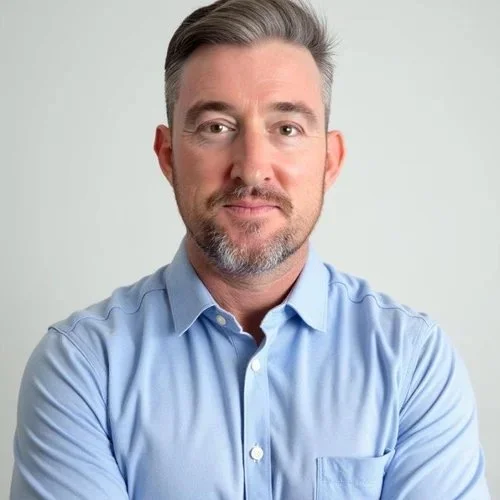
Luke Stoeckel, PhD
Harvard. Massachusetts General Hospital. 20+ years studying how cognitive change begins. Now putting that science to work for families here at home. Neuropsychologist, Vero Beach native.
Training
Harvard College (Psychology, AB). UAB (Medical Psychology, PhD). Harvard Medical School and Massachusetts General Hospital (Internship and Postdoctoral Training, Clinical Neuropsychology). Harvard, MGH, MIT, McLean Hospital (Postdoctoral Training, Cognitive Neuroscience).
Academic appointments
Assistant Professor of Psychology, Department of Psychiatry, Harvard Medical School. Director of Clinical Neuroscience, Department of Psychiatry, Center for Addiction Medicine, Massachusetts General Hospital. Visiting Scientist, MIT and McLean Hospital.
Research
More than 50 peer-reviewed publications and over 8,300 citations — in neuroimaging and neuroscience, cognitive aging, detecting and monitoring neuropsychological and decision-making change, test development and validation, dementia prevention and care. Much of it on the specific question of what can be detected before a diagnosis is possible.
Why I do this work
My grandfather was an Eastern Airlines pilot — sharp, precise, the reason I fell in love with science. Watching his cognitive decline, and watching our family navigate it with no map, is why I've spent my career on the earliest signals of change: the subtle shifts in memory and decision-making, the moment families first notice something is different.
In 20+ years of clinical training, research, and federal service, I kept meeting families who waited too long. Not because they were in denial, but because no one told them there was something they could do before crisis. Early action works. The care model for it didn't exist. So I came home and built it.
How I practice
Small by design. A handful of families at a time, each known well. That is a deliberate ceiling, not a stage I am trying to grow out of.
Research-grounded, and honest about limits. Every recommendation traces to evidence. When the evidence is thin — and in this field it often is — I say so rather than sounding more certain than the science allows.
Proactive, not diagnostic. I work alongside your physicians, not in place of them. Often I make their job easier, because they get better data than a clinic visit can produce.
Local. I do evaluations in your home. When something happens at seven on a Friday evening, you are calling someone who already knows your family.
What you're paying for
Not brief cognitive screening. That can be done with your PCP or in a community clinic. What is hard is choosing and interpreting the right set of tests for a particular person, over time, against their own history rather than a population average — and knowing which changes matter and which are noise. That judgment is what determines whether a family acts at the right moment or the wrong one. By the time the difference is obvious, the decision has usually already been made.
Florida Psychology License PY12718
PSYPACT® Interstate License 175709126
The research behind this approach is on the Evidence page. More of it, written in plain language for families, is on Stories.